A big elephant next to a small mouse, a tall tree beside a short one, and two baskets with different amounts of apples. Everyday comparisons like these give children a simple way to learn how to describe the things around them.
My comparing and describing worksheets for preschool help children practice words like big, small, tall, short, full, empty, more, and fewer through picture activities.
Children will compare objects, circle the correct answers, color pictures, and draw while learning about size, length, height, quantity, and other differences.
The activities are designed for preschoolers, with simple directions you can read aloud as your child works through each page.
Introducing comparison words with pictures
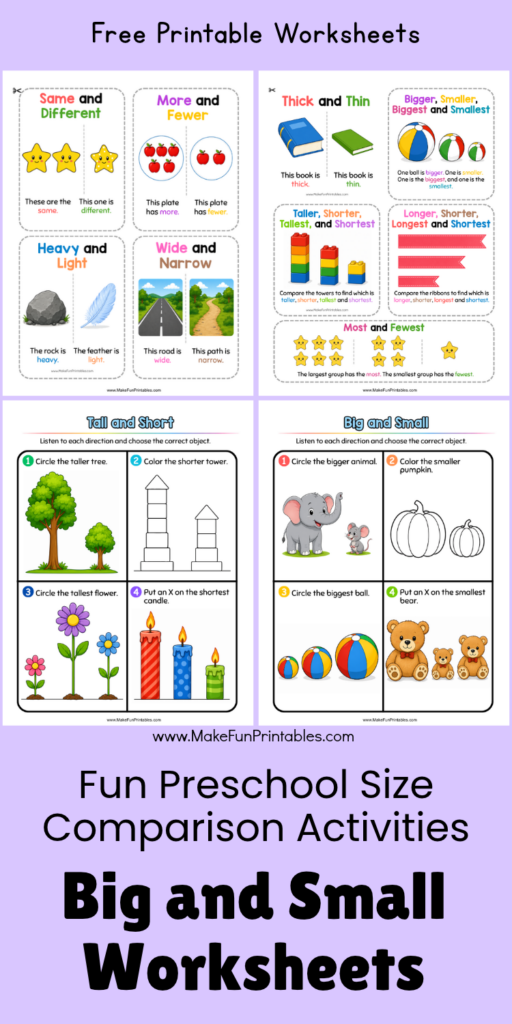
Before starting the worksheets, introduce a few comparison words using the illustrated reference cards.
Each card shows two or more pictures with simple sentences explaining the differences. Children can see a big elephant beside a small mouse, compare long and short pencils, or look at a full cup next to an empty one.
The cards introduce several types of comparisons:
- Size: Big, small, bigger, smaller, biggest, and smallest
- Height and length: Tall, short, taller, shorter, tallest, shortest, and longest
- Quantity: More, fewer, most, and fewest
- Other comparisons: Full and empty, heavy and light, wide and narrow, thick and thin
- Matching: Same and different
Start with one pair of words, such as big and small, and use familiar objects to demonstrate what they mean.
For example, place a large toy beside a small one. Ask your child to point to the bigger toy, then swap the toys around and repeat.
Once they understand the difference, move on to the matching worksheet.
Big, small, tall, short and everything in between
The activities focus on looking carefully at pictures, noticing differences, and choosing the correct answer.
Here’s what children will be doing:
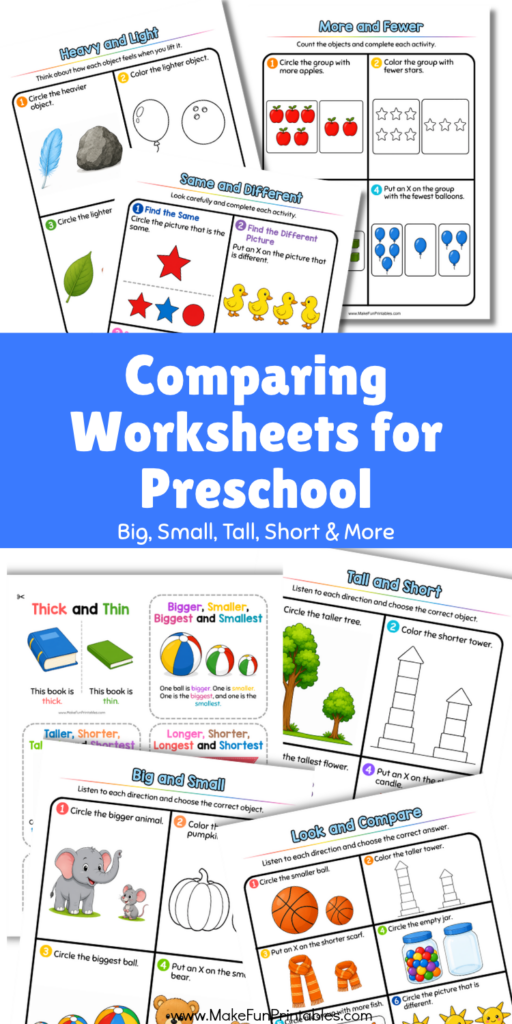
- Big and small: Circle the bigger animal, color the smaller pumpkin, and find the biggest ball.
- Tall and short: Compare trees, towers, flowers, and candles to find which are taller or shorter.
- Long and short: Find the longer pencil, color the shorter ribbon, and identify the longest snake.
- Full and empty: Circle the full cup, find the empty basket, draw apples in an empty bowl, and cross out blocks to empty a toy box.
- Same and different: Find matching pictures, spot the different duck, and draw a missing flower petal to make two flowers look the same.
- More and fewer: Compare groups of apples, stars, blocks, and balloons to find which have more, fewer, most, or fewest.
- Other comparisons: Identify heavy and light objects, wide and narrow roads, and thick and thin objects.
There’s also a mixed review worksheet where children use several comparison skills on the same page. An answer key is included for checking their work.
From bigger and smaller to biggest and smallest
One useful part of the worksheets is how the activities move from comparing two objects to comparing three.
Children begin with simple choices, such as finding the taller of two trees or the longer of two pencils.
Later, they’ll look at three different objects and identify the tallest, shortest, biggest, or smallest.
You can practice this with building blocks before starting the worksheets.
Build two towers of different heights. Ask your child which is taller and which is shorter. Then add a third tower and ask them to find the tallest and shortest.
The same approach works for comparing groups of objects. Start with two groups of blocks to introduce more and fewer, then use three groups to practice most and fewest.
Give children time to understand each comparison before adding another choice.
Learning to compare with everyday objects
You don’t need special teaching supplies to practice most of these concepts. Ordinary household objects work well.
Try a few simple activities before or after completing a worksheet:
- Put two pencils side by side and find the longer one.
- Fill one cup with water and leave another empty.
- Compare a feather and a small rock to talk about heavy and light.
- Place two groups of toys on the table and find which has more.
- Choose two matching socks, then add a different one and ask your child to spot it.
Encourage your child to describe what they see using the comparison words. Instead of only pointing to the bigger object, help them say something like “The red ball is bigger than the blue ball.”
For younger preschoolers, stick to one comparison at a time. There’s no need to complete every worksheet in one sitting.
What you’ll need to get started
Print the reference cards and the activity pages you plan to use. The cards can stay on their original pages or be cut apart for individual practice.
Most activities only require pencils or crayons for circling, coloring, and drawing.
If your child needs repeated practice, you can place the worksheets in dry erase pockets and use fine tip dry erase markers instead of printing them again. These are affiliate links.
For another activity involving looking for differences and sorting objects, try the cut and paste shapes sorting worksheets.
You can also use the numbers 1 to 20 worksheets for more practice with counting and recognizing quantities.
Free printable comparing worksheets for preschool
Help your preschooler learn to recognize and describe differences with picture cards and activities covering big and small, tall and short, more and fewer, and other everyday comparisons.
Get the printable worksheets below and start with a few familiar objects before moving on to the picture activities.